Saturday, May 17, 2014

Predappio, Mussolini's Hometown


A four-hour drive brought me, Ruth Lo, graduate student in Italian Studies at Brown, and Dietrich Neumann, professor at Brown, to a sleepy new town in a valley near Forli. One main street, with a piazza at one end, anchored by a church, the Casa Fascio (former Fascist Party headquarters) empty, boarded up at the corner. A few stores and public buildings dressed up in rather elegant neo-classical, safe for a few rationalist buildings. 

Here was Predappio, birthplace of Mussolini.

It underwhelms.  We were there on a Saturday and it was sleepy.  And, a bit to our disappointment, the public sites were largely inoffensive.  The fasces on the Casa Fascio have been removed.  The Church has no indication (unlike the one in Sabaudia did) of its fascist roots (except for the “EF” – era fascista – date).  The Town Hall has no obvious marks of fascism or Mussolini veneration.  Nearby is the rusted, overgrown cage for a golden eagle that was once kept there as a symbol of fascism.

Half way down the spine of the town, lined with a series of buildings by the architect Di Fausto – a school, affordable housing, a health clinic – is a semi-circular, colonnaded market place, a miniature version of Bernini’s columns enveloping the believers. There are no remains of fasces.  There was once a long stairway which headed up to Mussolini’s childhood home.  But BM wanted to cultivate his impoverished upbringing and had it removed.  Now a small path leads up to a substantial farmhouse. 

Remarkably, there is a temporary exhibit in his home that is appears scholarly and even-handed.  Indeed, the brochure goes out of its way, and at length, to say that this is not meant to celebrate Mussolini, or denigrate him, only to understand his earlier years.  And it by and large does that – although the large quotes from his speeches do veer toward the veneration side.  And in the upstairs part of the exhibit, there is a bedroom, with a photo of his alleged bed (there are no original objects in the museum).  But that’s it.  No shrine.

We then stopped in to the “souvenir” store and that is where things began to turn darker.  Two stores are chock full of tsotchkes of all types, if that Yiddish word is appropriate for the subject-matter.  The three of us had wanted to see this store, for its kitschy humor.  And in a way, it was ridiculous – I bought, for example, from “nostalgia” cologne with Mussolini’s image on the front of the bottle.  But we were soon appalled by the presence of Hitler busts and swastikas.  And then the three loud, tattooed young men came in speaking German – these seemed like true neo-Nazi’s from Germany.  Dietrich, who is German-born, heard the German and looked at me in shock. These guys were stocking up on swastikas and other things that are not allowed to be sold in Germany.  (Actually, we had heard that the former mayor had tried to bad these stores from Predappio, but had obviously failed).

Things went steadily down hill from there.  We visited Mussuolini’s crypt, where hundreds of people have left loving notes for Il Duce, and dozens of organizations have placed plaques on the wall, proclaiming their loyalty to Mussolini.  

We left Predappio but felt, rightly, that we should visit one last museum – his adult home, Villa Carpena.  This place is a shrine to the man, one of those house museums where everything appears frozen in time, so that visitors might nostalgically revisit a time and a hero.  The black-shirted guide spent two hours lovingly describing every plate and cup and picture, Mussolini’s skis, his motorcycle, his suit, his bed.  Perhaps it was because it was late in the day, but I became steadily more revolted by the whole place.  The culmination was their proud new “study center,” where people could come and read their collection of fascist books and magazines, and help keep alive the dream of Il  Duce.


I was happy to get in the car and drive, quickly, to beautiful Cortona.


View from the doorway of the church, with the Casa Fascio to the left.


Casa Fascio, the boarded up former home of the Fascist Party. The liberal mayor has proposed making it the home for a serious museum on fascism, which does not exist in Italy.

A cage next to Predappio's town hall, where a golden eagle, yet another symbol of the fascist regime, was kept for years.


The view up to Mussolini's childhood farmhouse, on a hall above the main street.  Di Fausto, the town's architect planned a grand staircase, but Mussolini had it removed, in order to emphasize his modest upbringing.

The marketplace serves as gateway to Mussolini's home.


Dangerous kitsch


The "guest book" in Mussolini's crypt was filled with emotional messages of loyalty and nostalgia for Il Duce.  The whole book had been filled in the last weeks because of the huge influx of fascist sympathizers who came on the anniversary of his death on April 28, 1945, just three days after the liberation of Italy, which is a national holiday.

Villa Carpena, just outside of Predappio, was Mussolini's home with his wife, and serves as a private museum, memorial and "study center."

The theme of St. George slaying the dragon, with Mussolini in the role of St. George, using the fasce's axe as weapon.

One of Mussolini's suits laid out on his bed. Nearby is a mirror which, when viewed from a certain angel, reveals an almost holograph-like image of Mussolini.


The tour ended with a visit to the top floor of Villa Carpena and the new "study center," with inspiration imagery and words on the walls, and stacks of fascist books and magazines lining the shelves.

Friday, May 16, 2014

Sacrifice of Isaac -- Three Interpretations


In Florence for a day, I found myself in the Bargello staring not at the glorious statuary the museum is famous for, but at two small panels, which served as competition entries by Ghiberti and Brunellschi for the 1401 competition for one set of doors of the Baptistery opposite the Duomo.  Both portray the Sacrifice of Isaac.  They stunned me with their similarity, and how far their mood is from how I think about that story.  In the place of awful silence, into which we can project the horror of a journey to this moment of the worst of all sacrifices, we see here now conviction and certainty.

This was one of the great architectural competitions of the Renaissance, marked by a dramatic conclusion in which the jury could not decide the winner and asked the artists to work together, to which Brunelleschi’s fled to Rome in prideful disgust.

The Ghiberti seems to me clearly the more powerful of the two – the rippling of the rock of Mt. Moriah lends dramatic energy to the climatic moment of the story, when Abraham is about to kill Isaac.  The Brunelleschi is much more   But they have largely the same interpretation of the climax of the story.  In both panels, Abraham holds the knife to Isaac, with fury and conviction, ready and seemingly willing to do his duty.  Isaac, in both panels, looks beyond his father to the angel, his savior.

There are, of course, important differences.  In the Brunelleschi the angel has its hand on Abraham’s arm in the act of stopping the murder; the Ghiberti takes place a few seconds earlier, just before the angel intervenes.  Brunelleschi’s Abraham has his hand to Isaac’s head, but looks at the angel who is grasping his forearm; Ghiberti’s looks right at Isaac, knife up high aiming for the throat.


Brunelleschi, Sacrifice of Isaac (1401)


Ghiberti, Sacrifice of Isaac (1401)


A few hundred yards away, and two centuries, is another famous portrayal of this event, with a wholly different sense. This is no Kierkegaardian painting, where Abraham is a “knight of true faith,” where Abraham is instantly accepting of his duty, where Isaac is silent and willing, and where there is no protest, but that of the angel.


Caravaggio’s Isaac  -- who looks remarkably like the figure of St. John the Baptist in another Caravaggio – peers out at the viewer from the bottom right of the painting, the strong left hand of his father on his face, and the knife inches away.  But Abraham is looking away, at the angel, who grabs his arm.  It takes all of the angel’s strength to hold him back.  The angel is pointing, not to Abraham and not to Isaac, but beyond.  What is out there?  Sarah, who will, along with Isaac, not speak with Abraham again, who will die not long after.  The people of Israel, who will forever be haunted by this act and this story, debating it every year on Rosh Hashanah, the holiday marking the birth of the world and the start of a new year.  The angel seems to say, you cannot do this to your future.  The madness ends now.

Abraham’s arm and hand around the knife remain flexed and tense.  But his head is turned to the angel.  What is that look in those eyes?  It is beyond anger, beyond sadness.  It is the ultimate in resignation.  “You think you are now saving me and you people?” he asks.  “You come to me now, when I have by this almost-act certainly lost my son, and my wife, and my people?”  The brow is furrowed with the ripples of the centuries of anguish over this story.


Thursday, May 15, 2014

Dante Slept Here


Winding roads up through the Emilia-Romagna region made Ruth and myself a little car sick - perhaps this was anticipation of the sickness we would feel on leaving the Mussolini veneration sites in Predappio. We stopped in San Godenzo, a delightful little village bisected by the road.  We thought we'd take a quick peek at the church above the road.  We popped into the cute little church.  The plaque just inside the door thanks, in large Roman font, "Il Duce Benito Mussolini," for restoring the church, and helping the town celebrate Dante’s presence

If Romanità (the veneration of ancient Rome with the aim of building the third Roman empire) was the dominant register of Mussolini’s cultural policies, fascism was also savvy its cultivation of regional loyalties.  In Tuscany, the cult of Dante – seeking out, or inventing, places associated with his writing and his exile – was part of building national pride.  And the reverse could be true:  Ruth notes that Domenico Venturini wrote a book in the 1920s, entitled Dante Alighieri e Benito Mussolini, which argued that Mussolini realized Dante's dreams.

San Godenzo plays its bit part in the story of fascism in the 1920s.  The little church was restored with the help of Mussolini's architects, the plaza renamed Piazza Dante, and as a result local pride, and loyalty to Mussolini, was strengthened.

Fascism’s marks are everywhere in this country. 


Johnson, Barr and Barr = Page, Neumann, and Lo

Philip Johnson Alfred Barr, and Margaret Scolari Barr, in Cortona in 1932, on a tour of Italy seeking out examples for what would be the International Style exhibition at the Museum of Modern Art in 1935.


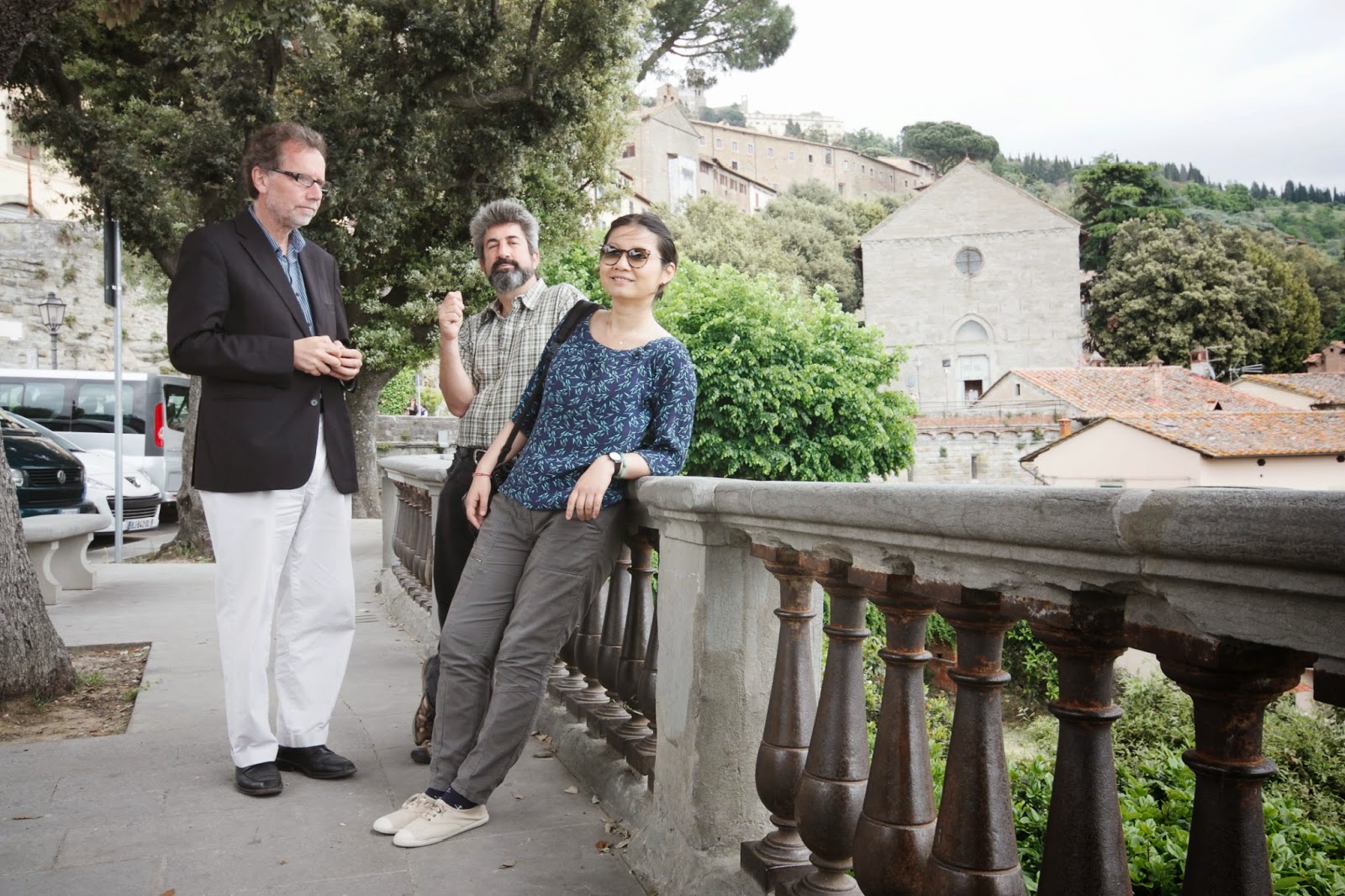
Max Page, Dietrich Neumann, and Ruth Lo, in Cortona in 2014, recovering from a visit to Predappio.


Wednesday, May 14, 2014

Japanese Garden....and a Gift from Japan


The experiences in Rome and Italy can be overwhelming, with so much to see and think about, and read and write about.  The Academy was welcomed into the home of the Torlonia family, in their beautiful 16th century palazzo on Via Condotti, right near the Spanish steps.  It was in this Palazzo that the Academy -- or the institute of architecture as it was known then -- had its first home, before eventually findings a permanent place on the Ganicolo.

After a lovely lunch on their patio overlooking the palazzos courtyard, Dietrich Neuman and I made our way to an appointment I had made two months ago -- for a rare opportunity to visit the Japanese Garden at the Japanese Institute, just beyond the Villa Borghese, and next to La Sapienza school of architecture.

Unfortunately, on the way up a staircase from the Villa Giulia (the home of Rome's Estruscan museum) we encountered one of the Mussolini's fasces, accompanied, for good measure, by someone painting a swastika on the adjacent wall. (Note the Roman numerals -- this indicates the "era fascista" -- the era of the fascist regime.  Buildings and monuments were often given both regular dates and the date of the construction, with 1922, the year of the March on Rome, being "year zero."  So, this fasce was installed in 1938, sixteen years 1922).


The garden was tiny but lovely.  The stunning event, however, was an old woman falling into the pristine silence of the koi pond!  She did scrape her leg but was okay, if soaking wet.


I thought I wouldn't be thinking about the Japanese garden again, after having thought a bit about them while writing about Carlo Scarpa, who was deeply enamored of Japanese architecture and landscape design.  I had no idea that when I went to Predappio and Mussolini's country house, I would find there next to the house, a gift of a sacred rock, like I had seen at the Japanese Institute in Rome -- this one a gift from World War II Emperor of Japan, Hirohito, to his ally, Benito Mussolini.


Fasce and swastika, followed by the natural serenity of a pond and sacred rock, which returns in the form of a dark symbol of an endorsement for Mussolini -- these are the headache-inducing contradictions of living in Italy while seeking the echoes of fascism.

Tuesday, May 13, 2014

Pienza


A man raised in a little town becomes Pope.  He returns to find his hilltop town to be run down and deeply impoverished.  He decides to rebuild (renaming it in the process – after himself) as a miniature, and first, model Renaissance town.  This is Pope Pius II in Pienza (formerly Corsignano) in the middle of the 15th century.

A man raised in a little town – actually in an other-side-of-the-tracks village near a little town -- becomes a dictator.  Inspired in part by Piena, he returns to his hometown, and merges the village and the town, makes his home an object of veneration, and provides a model for new town planning of future towns built south of Rome such as Sabaudia.  This is Benito Mussolini in Predappio (which absorbed Dovia di Predappio, Mussolini’s birthplace) in the 1920s.

Which all goes to show you: that so much of history’s actions – and certainly many of the worst actions – can be traced back to childhood trauma and insecurity, and inability to move beyond it without acts of grandeur and violence.  Tongue in cheek hyperbole, certainly, but with a touch of earnestness.

On our way home from Predappio and Cortona, we took a spectacular drive through Tuscany and stopped in Pienza for coffee and photographs. We were there on a special flower and plant market.

I picked up a slab of their specialty, pecorino, with bits of truffle inside.  And four tiny cacti.  Perfect, miniature worlds, like the miniature renaissance town that is Pienza, and like the rich pictorial and emotional world made by Cortona’s brilliant native son, Luca Signorelli’s, whose hand captures the reflection of burgundy (apologies: this color should be called “Montepulciano” in Tuscany) on the gold of a saint's dress. 


Duomo (14620


Dietrich Neumann and Ruth Lo


Luca Signorelli, Lamentation over the Dead Christ (1502, Museo Diocesano, Cortona)