Tuesday, March 4, 2014

Lorenzo Lotto


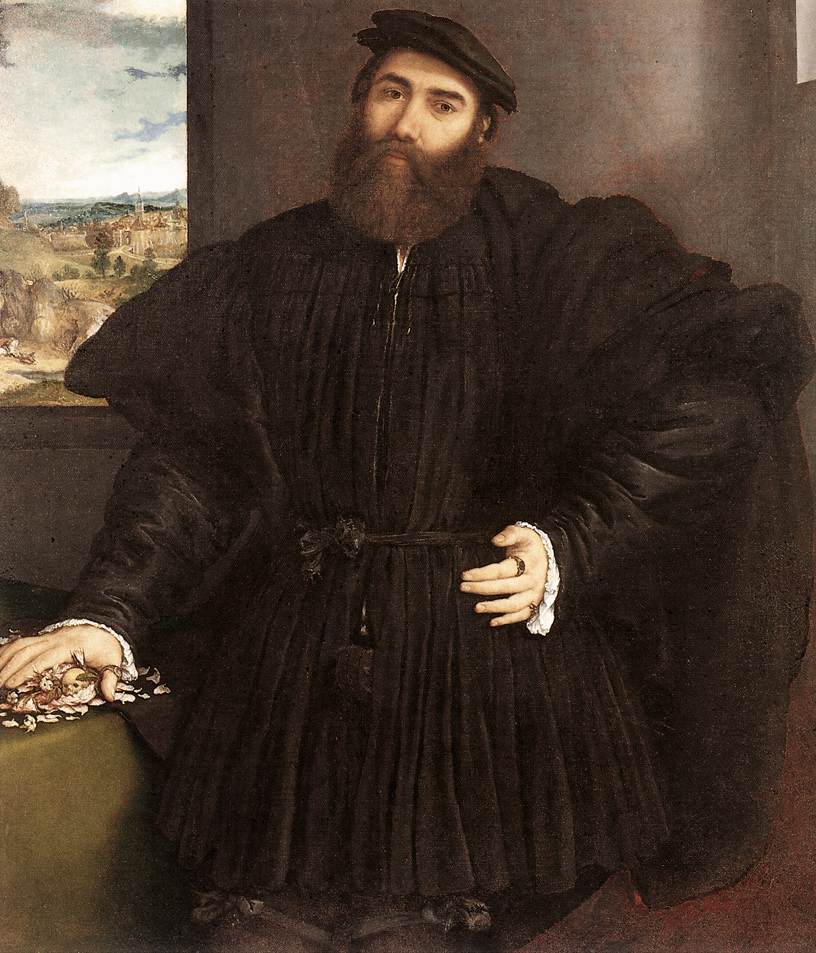
In one of the small rooms of the Galeria Borghese is a Portrait of a Gentleman (Ritratto di Gentiluomo) by Lorenzo Lotto.  It grabbed me the way Vermeer's Girl with the Pearl Earring grabbed me when I saw it at the Frick Gallery in New York just before coming to Rome.   Whether or not you know anything about the painter or the subject, you want to keep staring, in part because he stares back, but also because in staring back, he seems to open a pathway into a true understanding of this individual who lived five hundred years ago.  The gentleman, Mercurio Bua, a commander in  the Venetian army in the first half of the 16th century, rests his hand on a wreath with a small skull.  His neck is canted to the left, as if he doesn't have the strength or willingness to stand upright. One eye looks at us, sadly, the other seems to look beyond the viewer.  His lips are pursed.  This is the image of a man of wealth and stature, beaten down. 

Bernard Berenson, whose could be viciously dismissive, wrote, in his Lorenzo Lotto: An Essay in Constructive Art Criticism (1901), that Mercurio Bua looks as if the world were just dawning upon him again after a sorrow that had overwhelmed him like a terrible illness." (p. 259)  Bua's first wife died in 1524, after five years of marriage; his second wife, who he married in 1525, died in 1528.  The portrait was made just a few years after her death.  I had a sense of someone who had put himself together enough to sit for a portrait but was broken inside. Berenson rightly says that  "Lotto's psychological interest is never of a purely scientific kind. It is, above all, humane, and makes him gentle and full of charity for his sitters, as if he understood all their weaknesses without despising them, so that he nearly always succeeds in winning our sympathy for them."  
This image of Lorenzo Lotto moved me in a similar way to the statues of Giacometti at the Borghese did.   I wish they had chosen to place one of Giacometti’s compelling standing figuresin this small room, off the beaten parth of the Borghese’s greatest hits. Separated by so much time, culture, setting, materials, the works somehow tapped into a similar set of emotions:  broken hearts, but firm resolve; a fragileness but willingness to move forward; and under it all, a recognition that tragedy seems to wait in the wings.  Giacometti’s figures are inextricably bound up with the aftermath of World War II, when optimism would be ridiculous, but resilience was possible.  Lotto is of another time entirely, but that look, and those eyes, one peering into us, and another away, in a frozen gaze are of the same source. 
History does not move in a straight line, E. H. Carr long remarked (in a book I read before arriving for my first year in the History PhD program at the University of Pennsylvania).  “We sometimes speak of the course of history as a ‘moving procession.’” He wrote. “The metaphor is fair enough, provided it does not tempt the historian to think of himself as an eagle surveying the scene from a lonely crag or as a V.I.P. at the saluting base. Nothing of the kind! The historian is just another dim figure trudging along in another part of the procession….New vistas, new angles of vision, constantly appear as the procession—and the historian with it—moves along. The historian is part of history. The point in the procession at which he finds himself determines his angle of vision over the past.”
At any given moment, we may find ourselves closer to a particular age.  Bernini was despised by many observers (Dickens and Ruskin among them), only to now be treated with gasps of awe today.  Guido Reni was seen as a peer of Raphael, but now hardly known by the average person. And Lorenzo Lotto, famous in his own time, well regarded and sought after for his portraits, was then  overshadowed by others who followed in the late 16th century. He was undervalued for centuries. It was, in fact, Berenson who “rescued" him, at least for those in the English-speaking world. Even then, it was not until 1953 that there was a major exhibition about Lotto was held.
As Elaine Scarry has written, the experience of error is often the first step in the appreciation of beauty.  When we miss the beautiful in a tree, or a person, or a poem, it is not the end, but often the beginning of a journey, giving us the opportunity to fix the error, to gain a new, or renewed, understanding.
In my ruminations on how we decide what of our physical environment to save, I have been thinking a lot about our attitudes toward architectural death.  In U.S. preservation policy, we are all in or all out:  either a building is landmarked and therefore we believe it should be preserved, as much as possible as is, forever, or it is not landmarked and therefore free to live a short or long life, as per the owner's desires.  Our system is weak, so we have limited ability to insist on preservation (a building placed on the National Register of Historic Places one day can, in most places, be demolished by a private owner the following day).  But the idea still remains that if today we decide a building is of significance, we imagine it remaining of significance forever.  We have no middle ground, no way to either reconsider significance (although buildings that fall into great disrepair may lose their standing).  And we have a very inflexible idea of buildings changing, and even declining and then dying.
I have imagined that perhaps rather than having a system whereby there is one moment where we decide whether a building or place is significant or not, we instead have a regular system of evaluation – say, every decade.  We return to a building and ask about its importance, and reconsider its meaning.  It would give us a chance to think anew about what places matter to us, and which do not.
But I see dangers in this ideas, and this relatively obscure image by Lorenzo Lotto made me pause.  Had the painting I saw been a building, and thus much harder to preserve, it might easily have been dismissed as passé and torn down.  Indeed, the history of architecture is largely the history of demolition.  Had that happened here, we would have lost the opportunity to rediscover – hundreds of years later – a painting, and an artist, who somehow spoke to our time.

Smile of the morning

At Saturday's dinner at Eric Salerno's apartment I heard from Luca and Daniela Zevi's nephew about the soccer match he had just been to -- a big one, between Rome and Naples. But there were protests outside because the hardcore Roma fans were not allowed in.  Why? Because of this chant:  "Vesuvius, wash them (with) lava!"  Apparently there is a law against "territorially discriminatory chanting."  Naples in the past has been punished for chanting something to the effect of "We hope the Tiber will overflow its banks and flood the city."

Sunday, March 2, 2014

Orvieto the Beautiful

I just returned from a perfect afternoon in Orvieto with Tom Leslie, architectural historian and Pier Luigi Nervi expert.  Beautiful weather, a hilltop town, a world-renowned duomo (with Luca Signorelli frescoes that inspired and perhaps even exceeded Michelangelo's Day of Judgment in the Sistine Chapel), fantastic food, and, last but not least, a funiculare to take us from the train station to the top.

Here are a few images.


Hands

I have been confronted by a series of incredible images of hands here in Rome.

The obvious one, that everyone sees, is in the Sistine Chapel.  Almost touching, or having just touched.


I went to the Borghese Gallery, where one of the many prize Baroque sculptures is by Bernini, who shows off his incredible ability with the imprint of Pluto's hand on the thigh of Persephone in the Abduction of Persephone.  Like the illusion of architectural features in the ceiling of the Villa Farnesina, here, too, it is hard to believe that Bernini worked in stone, in one piece of marble.  The pressure on the skin is utterly realistic.  You can feel the pressure, and her attempt to flee.  


The Gallery Borghese is an unforgettable place, both for the building and for the series of masterworks, one after the other that are presented to visitors in two floors (including a room of four Caravaggio's, all of which deserve a room of their own and a half hour to appreciate).   To add to the riches, the Gallery is currently hosting an exhibition of Giacometti's sculptures, not in a separate space, but interspersed among the other works.

And here is the post-World War II sculpture by Giacometti they have placed adjacent to the Bernini. In the face of Bernini's confidence and even bravado is this this, fragile, but also resilient hand, reaching out after disaster.  Or is it the splayed hand and dismembered arm of one of the millions killed in World War II?


I went for the first time to the Borghese Gallery with my new friend, the photographer Gary Schneider and his partner John Erdman.  Gary is in the midst of a project of doing "portraits" of South African artists.  They are not facial portraits but rather hand prints on photograph negatives that are eerily powerful.  The hand, and the fingerprints, are as unique as the face, but we can only think of a portrait as being of a face.  


And finally.  I read a moving piece in The New York Times by Simon Critchley, a philosophy professor at NYU, about a television program from the 1970s in Great Britain, by the Holocaust survivor, mathematician and writer, Jacob Bronowski.  Critchley points us to one  of the last episodes in the series "Ascent of Man" where Bronowski explores the power, and danger, of human knowledge.  In trying to emphasize the danger of certainty, which can lead to intolerance, he takes his audience to Auschwitz, the site of the murder of his family members (and my own).  It is worth watching to see how he ends the episode with his hands. 


Saturday, March 1, 2014

Villa Farnesina

We were given an incredible tour of the Villa Farnesina, an early 16th-century villa (built by Agostino Chigi -- it was later acquired by the Farnese family, whose Palazzo Farnese gets much more attention) that some consider a peak monument of the Renaissance in Rome, by Mari Yoko Hara, a fellow at the Academy and an  expert on the under-appreciated architect and artist Baldassarre Peruzzi.

The photos of the frescoes don't do justice to the remarkable illusion conveyed but the painting.  I have never seen a painting this convincing, where I knew (after being told by Yoko) that the architectural elements of the ceiling were in fact simply painted on, but still didn't quite believe it.  Apparently, I am in good company:  Yoko related the story of a famous artist who remained stalwartly unconvinced.  But be assured:  everything you see (save for the few gold ornaments) is painted.


A curious and fascinating element of the Villa Farnesina is the graffiti left by the invading armies from the north in 1528.


One the image of an imagined tower for St. Peter's Basilica is scrawled "Babylon."


Tzedakah

I had planned to go to a nascent egalitarian minyan this morning, but woke up late and under the weather.  Instead, I got up and read another chapter of Aryeh Cohen's Justice in the City.  He opens chapter 5 with a reminder about the words of Isaiah which are read on Yom Kippur, chastising the people in the midst of their fast, for focusing only on themselves:  "Is this the kind of fast I have chosen, only a day for a man to humble himself?...Is it not to share your food with the hungry and to provide the poor wanderer with shelter....!"

Having planned to go to this new service in Trastevere, I felt a little badly that I went to the grocery store. But I arrived and there were a group of people mingling outside the neighborhood supermarket. It was the local food bank.  They were asking people to go in, buy some food off of a list, and then return it to them, in the plastic bag they provided.  I found this somehow even more meaningful than the food drives where we are asked to bring in canned food.  Why?  Because I went in and did my shopping, half for me, and half for the food bank and the people who need it.  I got to the cash register, paid, and filled my backpack with my food, and the plastic bag with "their" food.  It is a small contribution in a city and country that is reeling with unemployment and a broader austerity-induced economic crisis, but it felt closer to a "community of obligation" than most ways we give.

Reading Justice in the City, and coming across this food pantry effort, followed a seminar yesterday morning where Aldo Schiavone, who is giving a series of lectures on ancient Roman law at the Academy, walked us through Aristotle's Politics and specifically his discussion of slavery.  There too the city is glorified -- it is even prior to and higher than the family.  But it is a city of harmony born of inequality.  It is a city where the "community of obligation" is based on masters and slaves, the free and unfree.  The master and slave have the same interests, Aristotle argues, because they are two sides of the same coin:  the master, by his nature, rules, and the slave, by his nature, serves.

Modern progressive chumashim emphasize that the Torah and Talmud provide rights for slaves, and offer ways for them to be freed, but the uncomfortable truth is that Judaism too allowed for slavery of non-Jews and Jews alike.  Cohen offers a hopeful -- or demanding -- way out:  he insists that there is a "developmental arc" (p. 93) in Jewish thought over the course of a millennium, toward communal obligations to treat all as equal members of the community, to whom we owe care and support.